
_MakeBlendField Overview
DANGER
Some claims in this article have been proved incorrect. See this GitHub Gist.
WARNING
This part of the documentation only provides an outline of the algorithm.
INFO
The version of zombs_wasm.wasm this overview analyzes is from late 2024, which may not be 100% consistent with the current version.
Zombs.io employs an original method to validate players via Proof of Work (PoW) challenges that the client has to solve in order to enter a server and maintain a connection. It is a measure to occupy RAM and CPU resources of the client and, therefore, increase multiboxing costs.
The main algorithm of the PoW process is written in C++ and compiled into zombs_wasm.wasm with Emscripten. Reversing is very difficult due to the low-level nature of the WebAssembly (WASM) language it uses.
The core function zombs_wasm.wasm exposes is called _MakeBlendField. From now on, for convenience, _MakeBlendField will be referred to as MBF, and PACKET_PRE_ENTER_WORLD, PACKET_ENTER_WORLD, PACKET_ENTER_WORLD2 and PACKET_BLEND will be accordingly referred to as opcode 5, 4, 6 and 10.
History
April 24, 2021 - Minor Update
- Fix towers slowing down after some time due to floating point loss of precision
- Add a challenge / response system to help cut down on bot connections
- Harden game servers a bit against DoS attacks
MBF first appeared with this update, along with a WASM module to solve the new validation challenge. At this time, the validation process only employs a single challenge via opcode 5.
The way entering servers works has changed. Before:
- You send a "PACKET_ENTER_WORLD" message (opcode 4) containing your name
- The server receives, checks data, then sends you a "PACKET_ENTER_WORLD" message (opcode 4), allowing you in
Explains a community member, Apex, about how entering the game works before MBF.
March 6th, 2022 - Minor Update
(no changelog)MBF was upgraded around this time, introducing opcode 6 to the validation process, thus requiring the client to send opcode 6 upon entering the game.
INFO
There was a 25-use limit for the WASM module and a memory leak issue with it around this period, but it is unknown when the limit was removed or when the memory leak issue was fixed.
December 31, 2023 - Minor Update
- Security updateThis update introduces opcode 10.
Summary
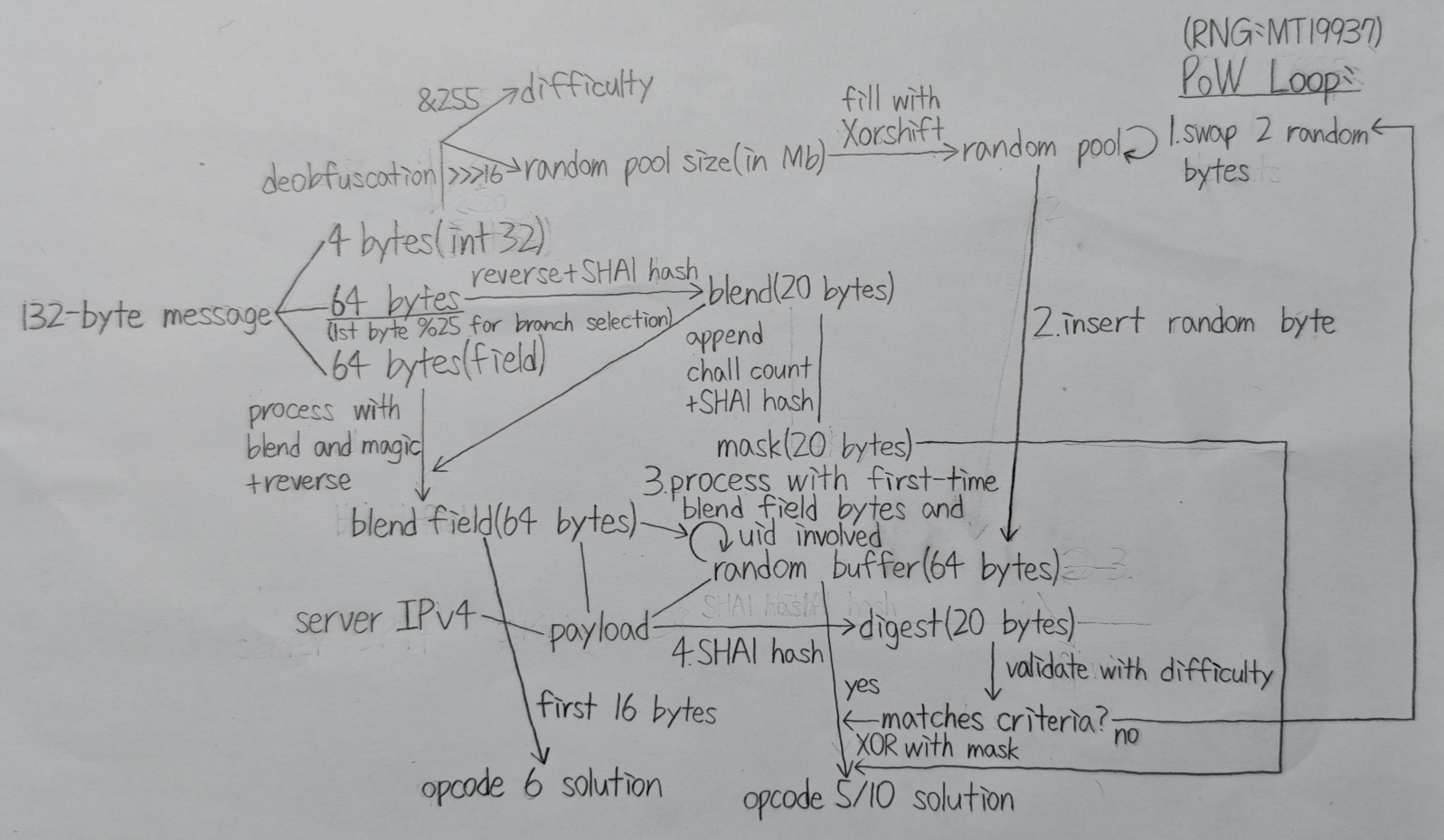
When the client receives an opcode 5 / 10 packet, it has to decode it with BinCodec and send back the required data. For opcode 5, the data will be sent along opcode 4 and 6 packets, while for opcode 10, a separate opcode 10 packet will be sent. If the client fails to submit data that passes validation within the given time, the client will not be able to enter the server and therefore will be forcefully disconnected from the server.
Challenge
An opcode 5 / 10 packet contains a 132-byte message, which can be represented by a Uint8Array, such as this one shown below:
[139,165,21,124,237,21,234,88,128,192,29,175,28,15,118,27,23,73,18,225,109,252,205,195,45,213,46,51,246,67,218,224,19,28,197,74,97,235,236,131,205,163,61,41,148,171,164,228,104,163,187,238,91,157,27,116,176,245,245,185,89,203,170,255,85,195,243,88,38,230,46,252,7,25,12,191,170,12,159,145,147,193,3,135,145,178,215,57,46,252,35,65,226,130,39,146,41,4,18,27,4,34,201,232,195,133,20,68,19,42,42,74,168,255,4,181,85,189,86,121,144,210,90,82,224,238,5,8,107,176,123,245]This message can further be split into 3 parts: a 32-bit integer (4 bytes) and two 64-byte segments.
The first byte of the first 64-byte segment is used to determine the logic branch used for the challenge (byte % <number of branches>, 0-indexed), where each branch adopts a unique set of constants in various parts of the algorithm. After deobfuscating the integer with a specific formula, two important parameters of the challenge can be inferred: the first 2 bytes (in big-endian order) is the size of the PRNG-generated pool (in megabytes), which will later be filled using Xorshift-generated numbers and be used to retrieve a random byte value in later steps of the algorithm while actually occupying memory with its sheer size; the last byte of the integer is the difficulty of the challenge, which determines the rarity of the solution and the time it takes to find such solution. For comparison, the pool size is usually 128 megabytes, while the difficulty is generally 17 for opcode 5 and 9-13 for opcode 10. The third byte of the deobfuscated integer acts as a flag byte whose lowest bit is usually 0, but if it is 1, a heavy penalty of 100 will be added to the difficulty, causing the challenge to become virtually unsolvable.
INFO
As of early 2025, after a few hours into the connection, opcode 10 packets may reach difficulty 19 or higher, while the pool size is increased to 512 megabytes (the theoretical limit is near 2048 megabytes), significantly increasing the cost of maintaining longer connections.
blend and field, which are both important components in the MBF process, can be obtained from the two 64-byte segments. They will be further elaborated in the upcoming sections.
Hash Functions
The hash functions of MBF's algorithm are derived from the SHA-1 hash algorithm, which produces a 20-byte (5 32-bit integers) hash value (digest) from any given input. The hash value changes drastically even with only a slight difference in the input, making creating a solution with the given result without guessing nearly impossible.
These hash functions resemble that of the original SHA-1 function, but with different sets of constants and partially modified logic for each branch.
blend, field, blend_field and mask
blend and field (unofficially named after _MakeBlendField) are two important components in the MBF process. blend is a hash value obtained via reversing the first 64-byte segment and hashing the reversed segment, while field is the second 64-byte segment itself. They together produce blend_field and mask, two crucial elements that participate in the actual PoW loop. blend_field is a 64-byte array produced from applying arithmetic to each byte of field with certain bytes in blend and a set of magic numbers (153, 111, 72 and 221), and eventually reversing the processed array. It is one of the segments that make up payload in the PoW loop, which will be explained later. The first 16 bytes of this array are sent by the client in the opcode 6 packet within a 100-byte ByteBuffer default buffer, like this one:
[161,229,245,1,88,44,180,171,255,85,253,126,113,49,212,239,0,0,0,0,0,0,0,0,0,0,0,0,0,0,0,0,0,0,0,0,0,0,0,0,0,0,0,0,0,0,0,0,0,0,0,0,0,0,0,0,0,0,0,0,0,0,0,0,0,0,0,0,0,0,0,0,0,0,0,0,0,0,0,0,0,0,0,0,0,0,0,0,0,0,0,0,0,0,0,0,0,0,0]mask is another hash value that is acquired from appending a 32-bit integer obtained from applying a specific conversion formula to chall_count (a 32-bit integer representing the number of PoW challenges the websocket has solved, including the current one) at the end of the array, and then hashing the resulting 24-byte array. It is used to "mask" random_buffer to create the PoW result sent by the client in the opcode 5/10 packet, which will also be explained later.
PoW Loop
In order to solve the PoW challenge, the client has to repeatedly change and hash the payload until one whose hash value matches the given criteria is found. The payload is an array that can be split into 3 parts: the server's IPv4 address as a string (without the null terminator \0), blend_field, and a 64-byte random_buffer.
The PRNG used in the loop is the standard C++ MT19937 generator paired with std::uniform_int_distribution. The seed of the PRNG is obtained from calling performance.now() in JavaScript through Emscripten features.
The steps are described below (every array is a 0-indexed byte array):
- Randomly choose 2 bytes in the random pool and swap them.
- Pick another byte in the pool randomly and insert it into a random position of
random_buffer. - Set
random_buffer[10/11/12/13]torandom_buffer[0/40/51/4] + random_buffer[23/25/50/45] + uid[0/1/2/3](uidis the player's uid expressed in a 32-bit integer) andrandom_buffer[14/15/16/17]torandom_buffer[41/22/35/39] ^ blend_field[0/1/2/3](Here,blend_field[0/1/2/3]is from theblend_fieldof the first challenge the decoder has solved, usually from an opcode5packet). - Hash the payload to generate a digest and validate it to check if it matches the criteria. The check is implemented as a leading-zero-bit test: the first
<difficulty>bits of the digest must all be zero. - If the digest meets the criteria, "mask"
random_bufferby settingrandom_buffer[i]torandom_buffer[i] ^ mask[i % 20]for every integeriin[0, 64); otherwise repeat step 1. The masked array is the result sent by the client in the opcode 5/10 packet, such as this one shown below:
[212,153,0,149,244,56,73,26,178,35,28,213,168,24,168,171,98,149,44,184,17,8,186,240,133,97,240,60,19,240,248,28,116,101,177,105,164,25,88,23,107,205,198,51,106,126,26,249,169,143,150,119,251,252,183,90,184,78,110,34,190,129,82,87]The server's IPv4 address and uid is obtained from evaluating JavaScript-side runtime values through Emscripten features. The decoder also performs environment checks through this kind of runtime evaluation as a part of the anti-bot mechanism - if the responses fail to match the expected browser context and game state, difficulty might be increased. There is even a final page-state guard before the MBF response is sent: the module checks whether the in-game HUD element has been populated. On the normal zombs.io web client, this merely serves as a sanity check, but in an alternate or non-web environment, the produced response can be invalidated by extra shuffling before it is copied out. This makes MBF depend not only on the mathematical PoW loop, but also on enough surrounding client state to resemble the real game runtime.
Bugs
When the zombs.io website client tries to connect to a server whose IPv4 address is shorter than one that the client tried before, it throws the error shown below because the _free() function isn't exported in zombs_wasm.wasm. Fix this by adding func $6 in zombs_wasm.wasm (which is the free() function in C++) to the exports. For custom clients instantiating zombs_wasm.wasm each time they connect, this can be ignored.

Trivia
- The abbreviation "MBF" can be inferred from the first 3 bytes of the instantiated WASM memory.
- When the client tries to decode an opcode
5/10packet using an outdatedzombs_wasm.wasmfile, the client may freeze or throw an error because using the wrong deobfuscation formula might yield an unreasonably high difficulty or random pool size, and thus trigger an indefinite loop or a memory overflow. - The term "0MB Wasm", often used by the zombs.io community, refers to custom MBF algorithms that significantly reduce RAM usage by limiting the size of the random pool. This can be achieved through either analyzing the logic and rebuilding the whole algorithm or directly manipulating
zombs_wasm.wasmby editing its text format (.wat). However, the mathematical nature of PoW challenges causes a significant reduction in CPU usage and computing time to be highly unlikely. (Otherwise ez cryptocurrency mining 😛)
Credits
- Article: AstralCat
- Preliminary research and base algorithm: ABCxff
- In-depth reversal and algorithm revision: AstralCat